Sunday, 4 November 2012

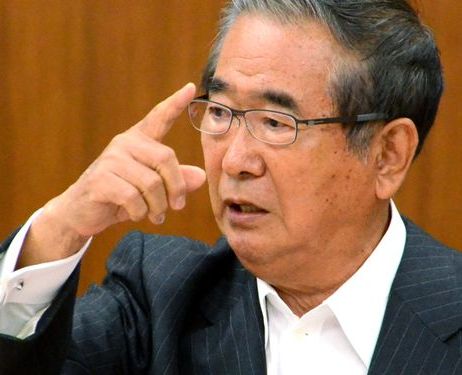
Shintaro Ishihara

It is not often you can conclusively point the finger at one man and blame him for the woes of a nation. Yet, here in Japan, we have a contender: step forward and take a bow, Shintaro Ishihara.


Up until last Wednesday he was the governor of Tokyo, quite possibly the most important political position after the prime ministership. However, after a run of 13 years he quit in order to found a new political party and run for the Diet, the Japanese parliament. Given that he is somewhere to the right of Texas in his extreme, conservative nationalism, it is highly unlikely he will become prime minister come the next election. He could though, become a 'shadow shogun', a behind the scenes kingmaker, who may well decide who does get the top job. He is also 80 so his ambitions are necessarily constrained and may explain his abrupt decision last week; it is, essentially, now or never.
My preference would be for the latter, but then again, I don't get to vote.
Besides having been governor, Ishihara is also a best selling author, film director, former journalist who covered the Vietnam War, an unapologetic racist, and, it would seem, politically (if not completely) senile. Earlier this year he announced that the Tokyo metropolitan government, at his behest, would buy the Senkaku Islands (the Daioyu Islands to the Chinese, Tioayutai Islands to the Taiwanese, or "those feckin rocks" to Cian). The islands form a rough apex between China, Taiwan and the Okinawa islands in southern Japan.


They are actually 1,900 kilometres from Tokyo, but to Ishihara that's the sort of bureaucratic nitpicking that have laid this once great nation so low.
After the second world war the islands were administered by the US, but following the reversion of Okinawa to Japanese sovereignty in 1972, the islands were returned to their private owners. At the time China contested this but weren't willing to force the issue as, well, this was 1972, Mao was in charge and the country was walking that fine line between state led second world power, and one rice crop failure away from third world famine.
Anyway, Ishihara is as anti-Sino as they come, (and lately they have been coming in droves), and his bid to buy the islands was widely seen as deliberate provocation to the powers that be in Beijing. Thus, the Japanese government, fearful of what he might do should the sale go through (probably borrow some neon signs from Shinjuku and erect a 100 meter display saying "Eat this, Mao spawn!"),  hastily stepped in and used ¥2.05 billion of my, my wife's and the rest of the Japanese taxpayer's money to buy the islands.


And this effectively nationalized them.
And this in turn sent the Chinese ballistic. Japanese stores and factories were ransacked and burnt down, workers at Japanese factories rioted, Japanese made cars were thrashed, and thousands tried to storm the Japanese embassy in Beijing. Throughout all this the Chinese authorities stood idly by, but rather less idly encouraged an armada of fishing boats to steam for the islands as well as dispatching numerous coast guard ships to enforce their territorial claim on the Senkakus. Sorry, Daioyus.


The authorities also took less overt but equally effective measures. Japanese imports were subject to strict customs checks; minor mistakes on the paperwork resulted in either cargo ships of good being sent back across the Japan Sea. Sorry, East China Sea.
Bowing to the inevitable various Chinese airlines terminated air routes to regional airports all across Japan while Chinese tourists cancelled their holidays en masse. All in all it was a concerted and pointed display of economic muscle, a rumbling reminder of who the big boy is in Asia now.
And it was all too painfully effective.


Exports to China fell by 14% in the month of September, and as the dispute continues with no end in sight, Cian reckons it will knock 0.8% of Japanese GDP for this year. For individual companies, the damage has been even more severe. Toyota has just reported a 40% drop in Chinese car sales while Sharp and Panasonic have announced billion dollar losses, with Sharp teetering on the verge of bankruptcy. Up here in Hokkaido we are not immune either. Tourism and agriculture, the two mainstays of the island economy have been particularly hard hit. According to 'De Paper', reservations by Chinese tourists are down 70%, and food exports are down by 40%.
And all because of the nationalistic hubris of a vain glorious old man. Yet Ishihara is not even a bit apologetic. Rather he believes Japan needs to be 'strong again' and berates the younger generation of politicians for not doing their fair share of geo-political weight training. And yes, that is a fairly stretched simile.
Anyway, for a country with the myriad of problems Japan faces, the last thing it needs is somebody like Ishihara gunning for glory, but this, unfortunately, fearfully even, is what we may well end up with.


Thursday, 1 November 2012

News

On Wednesday afternoons I teach at a nursing school in Date, a town some 25km down the coast from Muroran. On my way back I usually listen to the five o clock radio news, or at least that much I can understand. Natural disasters are fine - "Hurricane Sandy, like, ohmygod!", and more general topics such as this week is library week here in Japan are also pretty comprehensible; did you know for instance, that the average person borrows 5.8 books in a year, while for elementary school children that rises to a very impressive 27.3? Bet you didn't. On the other hand, matters political and economic are too full of intricate circumlocutions and polite sounding bullshit to make any sense, though I reckon that's the same for most countries. In the sports news I have no interest as there are, shockingly, no reports on Dr. Crokes' three-in-a-row success in the Kerry championship. And the weather, well that is probably the one aspect of my Japanese language ability in which I claim absolute fluency. Life in here in Hokkaido requires it - it's essentially a survival skill, same as deer hunting and clothing yourself in bear fur.
Anyway, I was driving home, listening to the news on NHK radio. Prior to the national news was the local Hokkaido news broadcast from Sapporo. Now I use the term 'local' advisedly. This isn't the equivalent of Clare FM, where Bazza Keane rules and everyday is a banner day. Hokkaido has a population larger than Ireland's, its regional domestic product is ¥18,360 billion (that's 183.6 billion of those increasingly dubious euro), more than Ireland's rapidly shrinking GDP of 168 billion; Sapporo, its largest city and the fifth largest in Japan, has a population of 1.92 million, making it considerably larger than Dublin's 1.05 million. So 'local' here is pretty much the equivalent of 'national' back home.
And I am digressing.
So, I am (still) driving home listening to the 'local' Hokkaido news. The main story is the inaugural direct flight from Bangkok to Sapporo heralding, it is hoped, a new source of foreign tourists now that the Chinese have stopped coming. The governor chirped some "it's a great day for the region, etc., etc.", while some hoteliers mangle their way through ยินดีต้อนรับ as they greet the first arrivals. Fair enough. Significant economic story. As the cold rain begins to pepper my windscreen I briefly consider making a dash for the airport and catching the return flight back to Bangkok.
The next story up, the second of the day, is about window cleaning at the Goryokaku viewing tower in Hakodate.
I kid you not.
Apparently after a good wipe the windows fairly sparkle, and visitors to the top of the tower can now happily peer at miles of dull, grey, autumnal cloudiness.
Like I said, second only to Thai Airways in the top news of the day. There wasn't, apparently, much else of note happening in Hokkaido on the last day of October. Which isn't entirely true; there was a fair bit, from car crashes to factory closures (unfortunately here in Muroran), as was reported in the following day's newspaper. But for the editors at NHK, these weren't as newsworthy.
This approach to news is quite prevalent in Japan. Unlike back home where news tends to explicate Hobbes famous dictum about life being "nasty, brutish and short", here in Japan they like to take time to smell the cherry blossoms and polish the windows. News tends to be balanced, not merely in terms of avowed neutrality to the topic (though this is debatable), but also in terms of positive and negative stories. You will of course get your required daily dose of gloom and doom, but you will also get reports on the record oyster harvest they are enjoying out Akkeshi way; or how one of the big hotels in Tokyo has started serving venison (I am not telling which hotel, but it's one of the big ones. The really big ones).
And these aren't the sort of winsomely humorous "dog saves duck from drowning" reports you get at the end of the news programmes back home. These are interspersed throughout the program, like the great glazed clean up high above Hakodate. In essence it is a differing perception of what constitutes news. And this in turn evinces a different way of looking at the world - more silver lining less cloud. And this day and age, that's no bad thing.


The Goryokaku Tower in Hakodate. Note the incandescent sparkle of the freshly cleaned windows.

Saturday, 27 October 2012

October

and I have been a bit sparse with the posts of late, I know. Unless I get my typing finger out, 2012 looks like coming in at under 80 (?) posts, well below my January resolution of cracking the triple figure mark. That said though, the nights are drawing in, the days are noticeably cooler and our collective motivation for  extended romps in the great outdoors is waning. More time for some idle thoughts perhaps, or then again bargain browsing on Sierra Trading Post (Marmot Vector Gore-tex Active Shell Jacket for only $150!! Me don't need, but me want, oh me so want, drool, slobber, succumb to default setting of mindless consumerism, etc.).
I do have a couple of things from September I will get around to posting at some stage, but not right now. As I don't know where the SD card with the relevant photos on it is, and I am wary of asking Sanae (tomorrow is the big Halloween party for Cian, his friends and his friend's mothers. And you wouldn't believe the amount of preparation that is going in to this thing. Nor the increasingly frazzled nerves its all leading to. Thus, I have hidden myself away downstairs in a dark corner, far from cut out pumpkins and sour apples. Tomorrow, I may well have to flee the house and take to the hills...).
Thankfully there are less participants than the M&M crazed hoardes who came last year. For the past couple of days I have been going up to collect Cian from his nursery school looking like this, and I think it had the desired effect.


Amidst the leaf strewn splendor of the hills, I will continue to (a) forage for nuts and berries to store for the coming winter; and (b) make incremental, one-grain-of-referenced-sand-at-a-time progress on my PhD. This topic will come to dominate my blog, life and quite possibly my death over the next 12 months. November marks the start of my fourth year and I am determined to finish it by this time next year as it is costing me a freaking fortune in time, money and surfable waves. As November 2013 approaches you can expect my posts to rapidly descend into splenetic incoherence until finally you'll just be left with,
All research and no play makes Brian a dull boy


Wednesday, 17 October 2012

Apologies

For the lapse in correspondence from this end. The new term has just started over here and I have been reacquainting myself with the somnambulant species, studentus disnterestedus. That and the ever elusive concept of 'teaching'; one of these days I'll figure both of them out.
I was also attending the Japanese Association of Language Teachers' (JALT) annual conference. This was held last weekend in the city of Hamamatsu, an unremarkable place principally renowned for its eel and musical instrument manufacturing.
There may well be some sort of the connection between the two, but it eludes me.
What struck me about the JALT conference, besides the abundance of harmonica playing eels, was the number of late middle aged men, a balding band of brothers, who had spent most of their working lives in Japan. These, I am beginning to realize, epitomize my most possible future. They have about them a sort of hollow bon homie. The years of forced effusiveness, of being professionally cheery, has left them with exhausted smiles and fleeting, scurrying wit.
They also drink a lot. So the exhausted smiles may well be the default facial setting for a serious hangover. And yet, could this be, ten, fifteen years from now, me?
My hair is certainly disappearing at a fair clip, though I finally seem to have my drinking under control (I don't). My face has this default smile/grimace setting and I can do forced empathy better than Mitt Romney. And with a mortgage, a family, and a country of origin in economic ruins, it would seem to be the case.
That is unless of course, the National University of Singapore come to their senses and realize that their faculty sorely lacks the sure-to-be inaugural winner of the Nobel Prize for Applied Linguistics.
And with that my smile would become genuine.

Friday, 5 October 2012

Our mission


The next day, yes, that's right, the very next day I found myself a sleepy member of the Great Forest Kozan Expedition in search of the legendary head waters of the Horobetsu river.

Apparently somewhere up river, beyond the Do Lung bridge, deep in the forest there is an old Ainu trader called Kurtz-san whose methods have become, well, 'unsound'. It was our mission to find him and "exercise our discretion vis-a-vis the termination of his activities".
Or I think that was what Sato-san's explanation back at the nature centre was all about. Then again, it may well have been a general warning to watch out for squirrels and falling chestnuts.
Off we set, braving the unknown and knowing the brave. Which would have been me and Cian.


Things were progressing nicely until we came to the 'Decent of Death' ©.


Followed almost immediately by its terrifying sequel 'Descent of Death 2: The only way is down!' ©


This was tough going. Some of the smaller kids started crying. So we staked them to the chestnut trees and let the rabid squirrels have them.
On we went. The sun shone, the wind whispered through the trees, the cries of the children grew faint in the distance. And then we heard water, then saw it, sparkling through the yellowing leaves.
The Horobestu river! And a crazed Ainu wood carver called Kurtz-san!!


But before that we had lunch. And it was such a splendid sunny day, we grew tired of the stretched-to-breaking-point Conrad/Coppola analogies, splashed around in the water a bit, and then went back.


And on the way back yours truly snagged some wild grapes (as opposed to his son's fingers in the car door - Hello Dave), thereby cementing his victory as 2012's 'Daddy of the Year', even though it's only October.


Friday, 28 September 2012

Fujisan


Before Ray came over to visit, he included this desperate entreaty in one of his emails:
"Is Mt. Fuji worth climbing".
Now, you don't need to be Harold Bloom to unearth the aching subtext contained in these 5 beseeching words. Ray is from Cavan after all where subtle understatement is as much a part of the county character as drumlins and potholed roads. Basically, what he meant was "Brian, please, please, pleeeease come climb Mt  Fuji with me. Please."
Look again at his question, nay plea: "Is Mt. Fuji worth climbing?" Note the use of the word 'worth'. I think I am not alone in detecting a certain dread, a certain sense of barely repressed fear even, in its implied hesitancy. Cuilcagh mountain (hill really), Cavan's highest point, is only 665 metres high; Fuji is six times that. Reassurance is being sought and it was mine to give.
Though then again, as they say up Blacklion way, I could just be full of auld sheep shite.
So plan "Let's Japan highest mountain together, forever, go yeah!!" was hatched. It ultimately involved 36 hours, 2 car journeys, 2 plane flights, 5 bus journeys and some climbing.
Motored up to Chitose airport; flew down to Haneda airport in Tokyo; bussed it into Shinjuku; took another bus to Kawaguchiko; and finally a bus to the 5th station on the Yoshida trail to the summit.
God bless Japanese transport - connections seamless and everything on time (except for Ray's luggage which took an inordinate amount of time to appear at Haneda arrivals). I even had time to go shopping for a gas canister after being forced to dump one by baggage security at Chitose airport. I mean me, an Irishman, and a potentially explosive device, what could they possibly be thinking?
So we arrive at the 5th station which is 2,300 metres up the mountain. So yes, we cheated, as do most people, but 36 hours was all my wife gave me. But it's Fuji, I tried explaining to her, your country's highest, most sacred mountain. But you have to be back here by tomorrow evening she replied, and handed me my car keys.
And we had to climb it at night. Well, we didn't really have to climb it at night, but the tradition, and Japan is a country that places a premium on its traditions, is that you reach the summit just in time for sunrise or goraikou in Japanese. Apparently the view is so spectacular it brings tears to your eyes.
With this mind we packed an extra packet of tissues, checked the batteries on our headlights and started off at 6:30pm. It was now dark, the mountain had been gently enveloped in a thick swathe of fog and we figured all we had to do was keep going up. So no surprises then when just 20 minutes after setting off, we managed to wander off the trail and found ourselves climbing up a rather steep construction site access track.
Back down we went. Rejoined the correct trail and back up we went. And went. For about two hours until we arrived at the mountain hut where we were to spend the night. Or at least that part of it until 1:30 in the morning when we work woken and told to be best on our way if we wanted to get to the top in time for goraikou.
It was cold. Quite cold. There was a stiff breeze blowing which had turned the fog into a drizzle and apparently it was blowing harder further up. Typical Cavan weather in other words.
We kept going.
At the 8th station (there is a series of stations from the fifth to the ninth, marking off the trail), we stopped for a rest. Not that we really needed it (ahem), but at the pace Ray was leading me we would be up and back down the mountain before dawn broke. Plus, we figured it would better to kill some time softly here rather than being blown out of it further up.
So, being Irish, we had a cup of tea. While some of our fellow Japanese climbers, God bless them, sucked on small portable canisters of oxygen.


Fortified by hot tea and mars bars we started off again. But even that turned out to be a tad rushed as we reached the summit some 30 minutes before the sun was due. Not that it seemed we'd have much chance of spotting it. The wind was howling, the snow was blizzarding and the carcasses of frozen sherpas lay strewn around the ground.
Kind of.
There was wind. And rain. No sherpas, though the boys who had been sucking on the oxygen back at the 8th station looked like they needed some. No sun either.
And we waited. And got colder. And this blog became Hemingwayesque.


The sun finally did break through the clouds and there were tears. But that was the wind. 


We stumbled around the summit rim for a bit. Had another cup of tea. Breached the weather station perimeter to reach the true top of Fuji.


Took some photos with my not very good camera.


Then down we went. And the cloud cleared, the wind dropped and Ray decided it was time for a recline.


And yes, dear reader, I was back in Muroran by that evening while Ray took his Men's Health cover shots off to Kyoto.

Monday, 24 September 2012

A visitor

In a surprise visit my friend Ray came to see us here in Muroran. Ray and myself first met exactly 20 years ago on the steps of a BMW wohnheim in Munich. Subsequently we went to Australian together and after that lived a couple of months dangerously in Indonesia. And while I eventually washed up here in Japan, Ray kept travelling. And travelling. And travelling some more. To the point where he has now visited 81 countries all told.
To which I thought, "there but for the grace of my wife, went I".
Japan was the 82nd stamp in his passport and in a climatic show of welcome to such an august visitor,  Muroran rolled out the blue skies and sunshine for him.


After being so cynically robbed at the sport's day the previous weekend, Cian showed his disgust by willfully absenting himself from the nursery school for a couple of days. He wanted to go on hunger strike to draw attention to his campaign for 'clean sports', but then he got hungry and gave it up just before breakfast. Instead he joined Ray and myself for our grand tour of western Iburi.


Ray was impressed.
Ray should be here in the dark, wind blown depths of a frozen February, but even I, grudgingly, very grudgingly, could see that Muroran, on a day like today, might just faintly brush up against the distant reaches of the word 'scenic'.
Next up a pit stop for some damn fine sushi - ahh Muroran, you gastronomical tease.


Then off to Uzu-san, our local, semi-active volcano for a bit of that old 'Japan - land of disasters' experience.


And finally onto Lake Toya because (a) it has its serene moments and we were lucky enough to capture one of them; and (b) it also has its delicious, home-made ice-cream.


In 神様`s country

It was the Emperor's birthday yesterday (he turned a sprightly 65 - Banzai!), so us common people were given a holiday to celebrate his ...